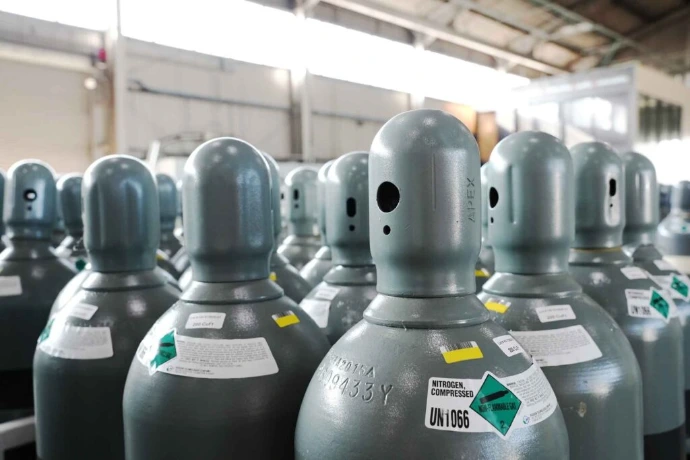
What is helium, and why do balloons float with it?
Helium is a noble gas, and that word immediately dispels the most important misconception: it is completely inert and therefore not flammable. A helium balloon cannot explode like the infamous hydrogen balloons of the past; the worst that a helium balloon can do is pop.
A balloon floats for a simple reason: helium is much lighter than air. Fill a balloon with enough helium to carry its own weight plus that of the latex or foil, and it will rise. That’s why larger balloons float more easily and for longer: more volume means more lift. And that’s why very small balloons don’t float at all: a 5 inch balloon or a modelling balloon simply has too little volume to lift its own weight, with no amount of helium.
How much helium does each balloon size need?
This is the official Sempertex Gas Capacity Chart, the table with which you calculate every helium job in advance:
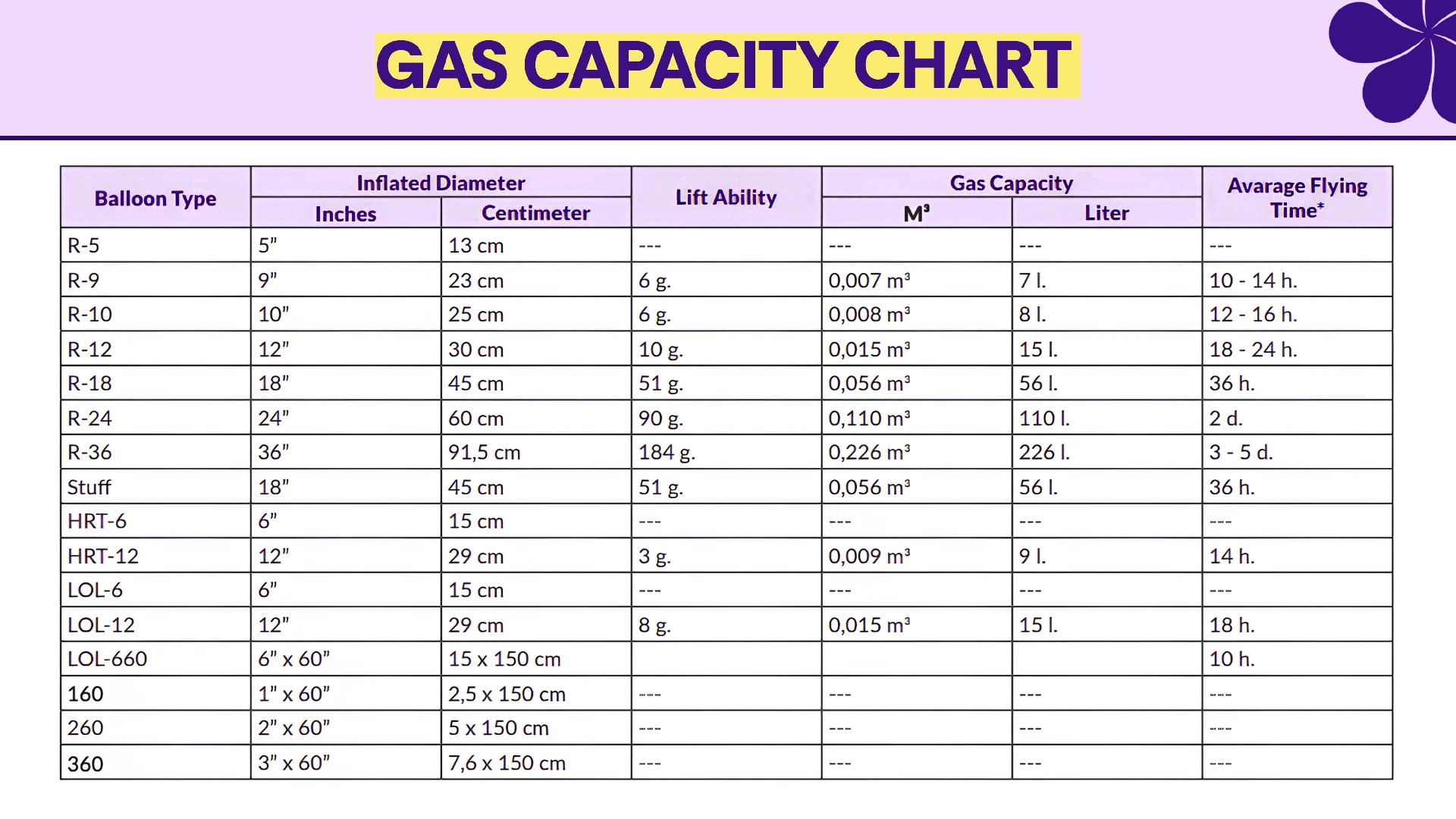
Here’s how to calculate it: add up the litres of your design, and divide the contents of your gas cylinder (which is listed in cubic metres on the cylinder, 1 m³ is 1,000 litres) by what one balloon requires. A cylinder of 1 m³ therefore roughly gives 66 balloons of 12 inches, but barely 4 giants of 36 inches. That difference is immediately the most important pricing lesson from the table: a 36 inch balloon uses 15 times more helium than a 12 inch, and that’s something your quote should know.
When do you use helium, and when just air?
More often air than you think. The rule of thumb is simple: helium is only for designs that need to float freely. Balloon bouquets on a weight, floating ceiling decorations, that sort of thing. Everything else, and that’s the majority of modern decoration work, you fill with air: garlands, arches on frames, backdrops, organics, table centrepieces. Those are either hung or stood firmly, so helium adds nothing except cost.
That choice is also simply professional: helium is a finite resource and, as the table above shows, one of your biggest variable costs. Those who use air where they can and helium where they must create more competitively priced quotes and a more sustainable story, and the latter is increasingly important to more customers.
This is how your balloons float longer
Four things determine how long your helium work stays afloat:
- Treat latex with Hi-Float. A thin layer on the inside before inflating extends the float time by up to twenty times. For installations that need to last a night or a weekend, this is the standard. Only for latex; foil does not need it.
- Foil retains helium longer. Foil balloons float for days without treatment.
- Timing. Untreated latex should be inflated on the day itself, as close to the event as possible. With Hi-Float, it can be done the day before. Foil can be done days in advance.
- Temperature. Heat expands the helium and stresses the latex, cold causes balloons to temporarily shrink and hang lower. Both recover, but plan your transport accordingly and never leave helium work in a hot car.
What you avoid
- Never inhale helium. The funny voice displaces oxygen from your lungs and that is downright dangerous. Always use a pump or the tap of your bottle, never your mouth on a balloon full of helium.
- Never release balloons. Every released balloon ends up as litter. Why we do not support releases read here, including the nicer alternatives.
- No helium in small or modelling balloons. A 5 inch balloon or a 260 does not float, no matter how much helium you push in; that's just wasting gas. Small sizes are for air-filled work.
- Always anchor. Each floating design gets a weight, each helium balloon individually secured. Even indoors, because you need to be able to access it.
- Handle bottles safely. Upright, secured during transport, and stored in a ventilated place out of the sun.
- Do not waste helium. The most expensive habit in the industry: helium in designs that could just as well be done with air. Your margin and the environment will thank you.
Frequently asked questions
Hoeveel helium heeft een ballon nodig?
Een 12 inch ballon heeft ongeveer 15 liter helium nodig, een 18 inch 56 liter en een 36 inch reus 226 liter. De volledige tabel per maat staat in de Sempertex Gas Capacity Chart, gratis te downloaden op de Inspiration-pagina.
Hoe lang blijft een heliumballon zweven?
Onbehandeld latex gemiddeld: 10 tot 14 uur voor een 9 inch, 18 tot 24 uur voor een 12 inch, 36 uur voor een 18 inch en 3 tot 5 dagen voor een 36 inch. Met een Hi-Float behandeling zweeft latex tot twintig keer langer, en folieballonnen houden helium uit zichzelf dagen vast.
Is helium gevaarlijk of brandbaar?
Helium is een inert edelgas en niet brandbaar, een heliumballon kan dus niet ontbranden of ontploffen. Het enige echte risico is helium inademen: dat verdringt zuurstof en is gevaarlijk, dus doe het nooit.
Kan ik helium en lucht mengen in een ballon?
Voor zwevende designs niet: elke lucht die je toevoegt vermindert de draagkracht en de zweeftijd. Voor vastgemaakte designs zoals garlands sla je helium gewoon volledig over en gebruik je enkel lucht.
How much helium does a balloon need?
A 12 inch balloon needs about 15 litres of helium, an 18 inch 56 litres and a 36 inch giant 226 litres. The full table per size is in the Sempertex Gas Capacity Chart, free to download on the Inspiration page.
How long does a helium balloon float?
Untreated latex on average: 10 to 14 hours for a 9 inch, 18 to 24 hours for a 12 inch, 36 hours for an 18 inch and 3 to 5 days for a 36 inch. With a Hi-Float treatment, latex floats up to twenty times longer, and foil balloons hold helium for days on their own.
Is helium dangerous or flammable?
Helium is an inert noble gas and not flammable, so a helium balloon cannot ignite or explode. The only real risk is inhaling helium: it displaces oxygen and is dangerous, so never do it.
Can I mix helium and air in one balloon?
Not for floating designs: every bit of air you add reduces the lift and the float time. For attached designs such as garlands, you skip helium entirely and use air only.
De combien d'helium un ballon a-t-il besoin?
Un ballon de 12 pouces a besoin d'environ 15 litres d'helium, un 18 pouces de 56 litres et un geant de 36 pouces de 226 litres. Le tableau complet par taille se trouve dans la Sempertex Gas Capacity Chart, telechargeable gratuitement sur la page Inspiration.
Combien de temps un ballon a l'helium flotte-t-il?
Latex non traite en moyenne: 10 a 14 heures pour un 9 pouces, 18 a 24 heures pour un 12 pouces, 36 heures pour un 18 pouces et 3 a 5 jours pour un 36 pouces. Avec un traitement Hi-Float, le latex flotte jusqu'a vingt fois plus longtemps, et les ballons en aluminium retiennent l'helium plusieurs jours par eux-memes.
L'helium est-il dangereux ou inflammable?
L'helium est un gaz noble inerte et non inflammable, un ballon a l'helium ne peut donc ni s'enflammer ni exploser. Le seul vrai risque est d'inhaler de l'helium: il remplace l'oxygene et c'est dangereux, donc ne le faites jamais.
Puis-je melanger helium et air dans un ballon?
Pas pour les designs flottants: chaque ajout d'air reduit la portance et le temps de flottaison. Pour les designs fixes comme les guirlandes, vous sautez completement l'helium et utilisez uniquement de l'air.
Wie viel Helium braucht ein Ballon?
Ein 12 Inch Ballon braucht etwa 15 Liter Helium, ein 18 Inch 56 Liter und ein 36 Inch Riese 226 Liter. Die komplette Tabelle pro Groesse steht in der Sempertex Gas Capacity Chart, kostenlos zum Download auf der Inspiration-Seite.
Wie lange schwebt ein Heliumballon?
Unbehandeltes Latex im Durchschnitt: 10 bis 14 Stunden fuer einen 9 Inch, 18 bis 24 Stunden fuer einen 12 Inch, 36 Stunden fuer einen 18 Inch und 3 bis 5 Tage fuer einen 36 Inch. Mit einer Hi-Float Behandlung schwebt Latex bis zu zwanzigmal laenger, und Folienballons halten Helium von selbst tagelang.
Ist Helium gefaehrlich oder brennbar?
Helium ist ein inertes Edelgas und nicht brennbar, ein Heliumballon kann also nicht entflammen oder explodieren. Das einzige echte Risiko ist Helium einatmen: es verdraengt Sauerstoff und ist gefaehrlich, also mach das nie.
Kann ich Helium und Luft in einem Ballon mischen?
Fuer schwebende Designs nicht: jede Luft, die du hinzufuegst, verringert die Tragkraft und die Schwebezeit. Fuer befestigte Designs wie Girlanden laesst du Helium komplett weg und nutzt nur Luft.
Download de Gas Capacity Chart
Alle heliumvolumes, draagkracht en zweeftijden per ballonmaat op een blad. Print hem, hang hem in je studio, en offreer elke heliumjob met zekerheid.
Naar de downloads
Download the Gas Capacity Chart
All helium volumes, lift ability and float times per balloon size on one sheet. Print it, hang it in your studio, and quote every helium job with confidence.
To the downloads
Telechargez la Gas Capacity Chart
Tous les volumes d'helium, la portance et les temps de flottaison par taille de ballon sur une seule feuille. Imprimez-la, accrochez-la dans votre studio, et chiffrez chaque projet helium en toute confiance.
Vers les telechargements
Lade die Gas Capacity Chart herunter
Alle Heliumvolumen, Tragkraft und Schwebezeiten pro Ballongroesse auf einem Blatt. Druck sie aus, haeng sie in dein Studio, und kalkuliere jeden Heliumjob mit Sicherheit.
Zu den Downloads