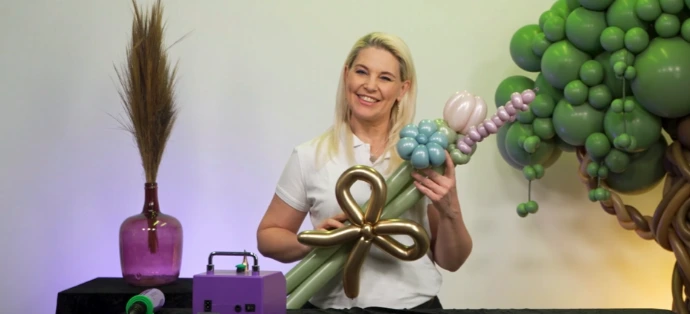
What do you need for a balloon bouquet?
The materials below were used in our tutorial. The colours and how many balloons you use depend on the situation.
All the balloons used here are modelling balloons, 260s. Each flower only needs 3 times a 260. one 260 for the flower, one for the stem, and one extra for the bow. Other supplies are a hand pump and a cutter.
- A tulip. The colours we used: Pastel Dusk Rose for the flower and Eucalyptus for the stem.
- Lavender. Of course, Pastel Dusk Lavender and again Eucalyptus.
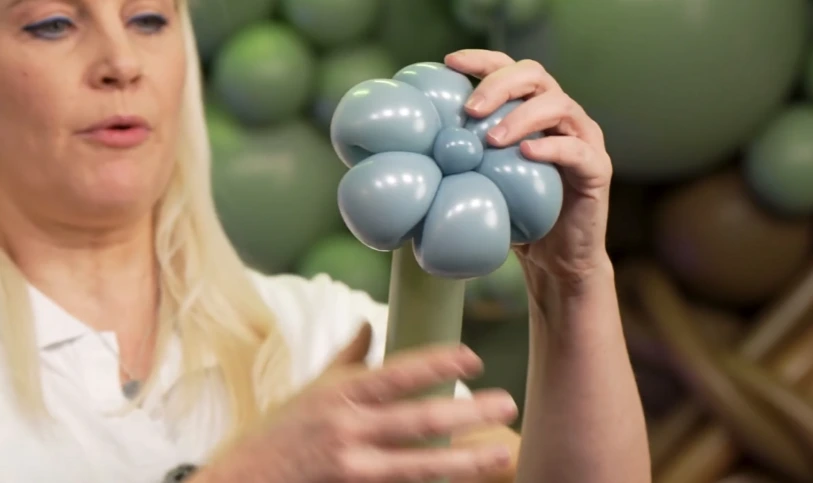
- Six-petal flower. For this we used Pastel Dusk Blue for the petals.
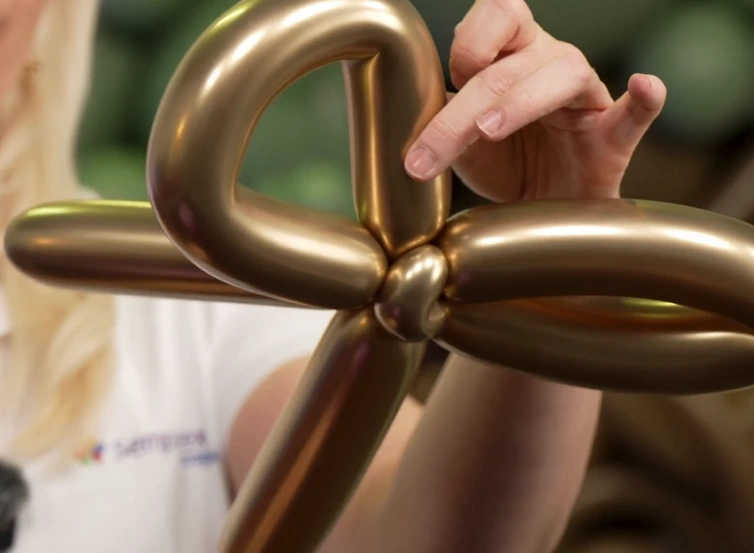
- Bow. For the bow, it's best to use a striking luxurious colour such as Reflex Gold.
Three rules before you start
To avoid making mistakes, you should think of the following three things:
- Never inflate your balloon all the way. Each 260 in this tutorial has a good length of uninflated tail. You need that space to twist. Each twist pushes air back into the balloon.
- Keep your bubbles small and even. You can best measure this with your fingers. Here we have a separate tutorial for.
- Twist each twist two or three times. Always in the same direction. A twist that you don't secure properly will become loose and lose its shape.
Flower 1: the tulip
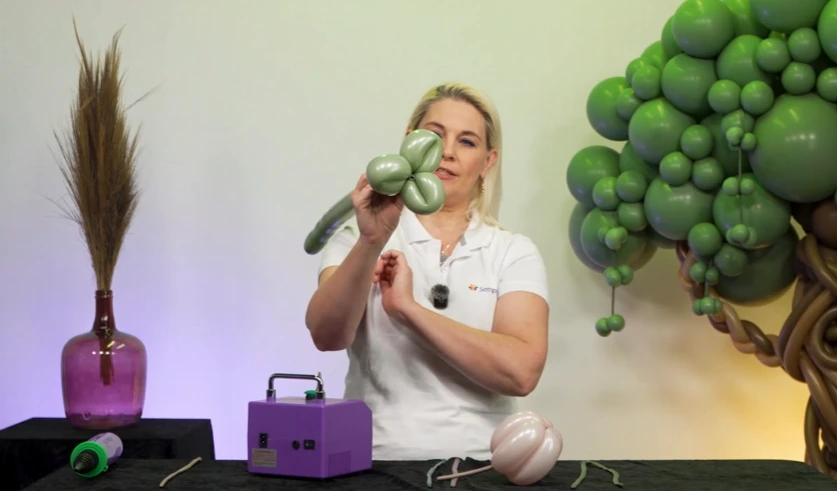
The tulip is a cluster of five petals from one 260. This is the simplest of the three.
- Inflate the Pastel Dusk Rose and leave a good length of tail free. Make a first bubble, fold it over and pull the knot of the balloon all the way through to lock it.
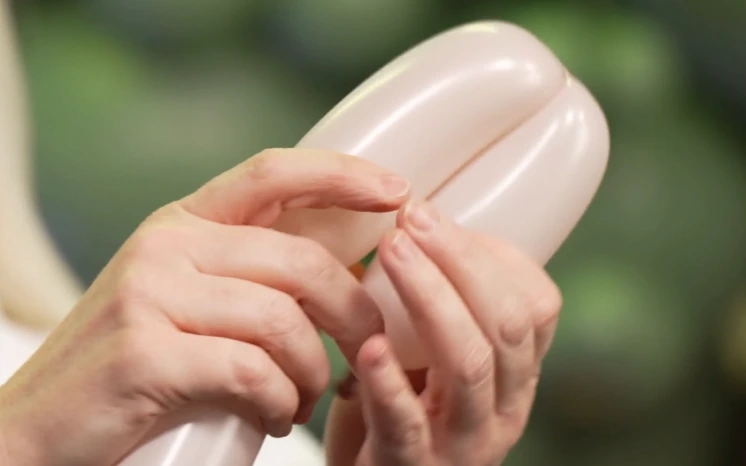
- Make two petals of exactly the same length. Pull the first petal up and over the other, and roll it towards the centre of the tulip.
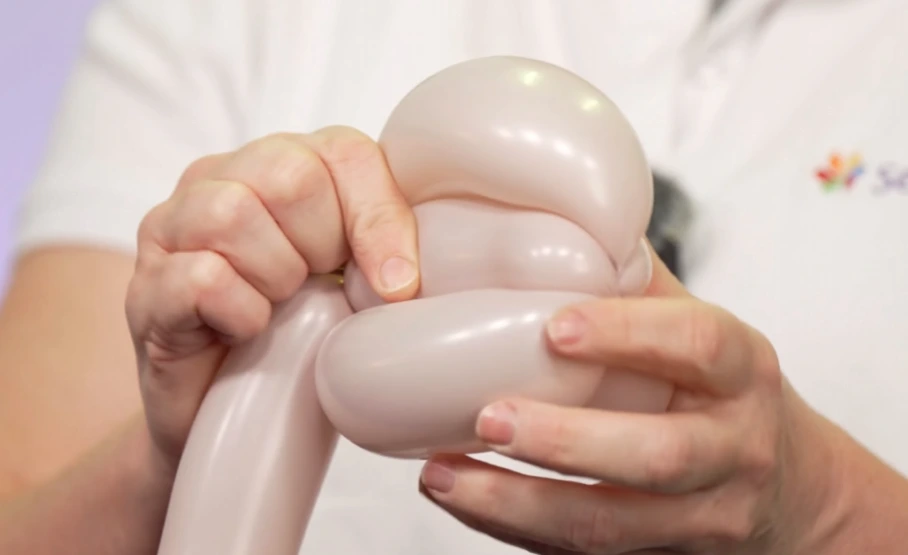
- Make the remaining petals. The excess you roll inwards, all the way down, and pull it through.
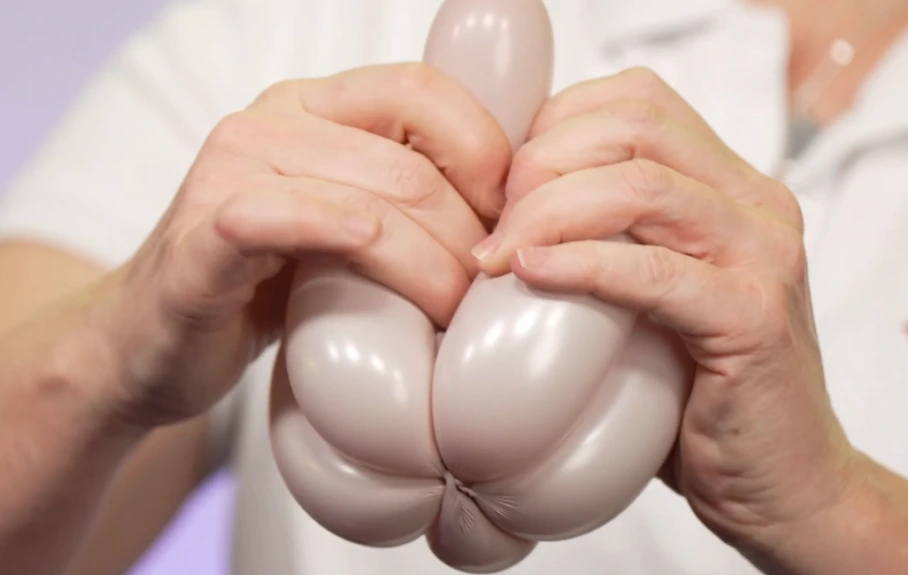
- Let the excess hang, that will be your knot point on the stem.
For the stem, inflate a Eucalyptus 260 almost completely and create a base of three loops at the top. In the middle, twist them together and then open them up so that the tulip can sit on top. If you want a longer tulip, make your petals longer; the technique remains the same.
Flower 2: the lavender
The lavender is one long repetition of three steps: a bubble, a pinch twist, and another pinch twist. You follow that pattern down the entire stem, and it gives that typical lavender texture. How does the pinch twist work? Make a bubble that is slightly smaller than your regular bubble. Then make a second bubble and twist it around its own axis. Hold the previous bubble with your other hand, otherwise it will untwist while you twist. You repeat this process for the entire flower.
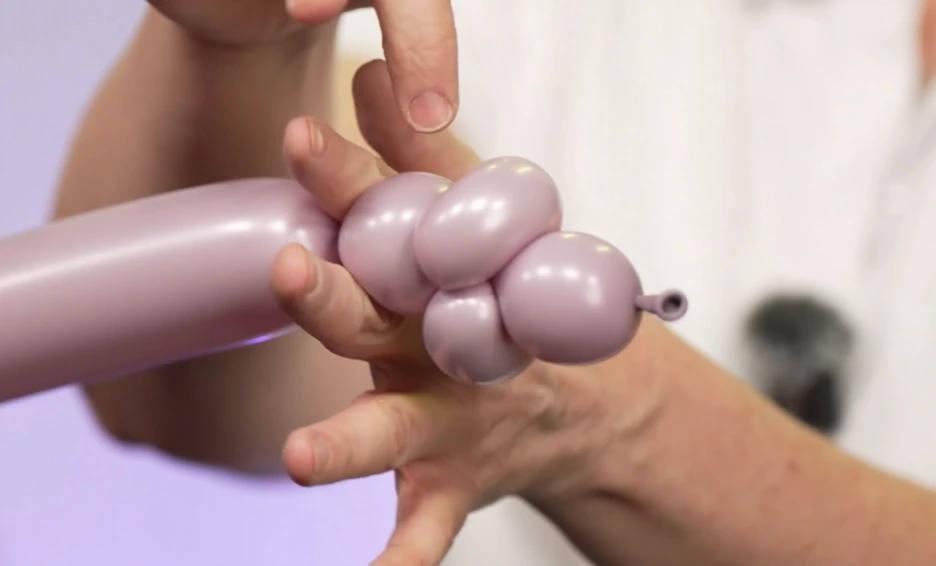
For the base, you can repeat the process of the stem.
Pro tip
De pinch twist is de belangrijkste techniek die je uit deze tutorial moet meenemen. Hij zit in de lavendel, de zesbladige bloem en de strik. Oefen hem op een losse 260 tot je pinch twists allemaal even groot zijn, dan gaan de bloemen daarna vanzelf.
Pro tip
De pinch twist is de belangrijkste techniek die je uit deze tutorial moet meenemen. Hij zit in de lavendel, de zesbladige bloem en de strik. Oefen hem op een losse 260 tot je pinch twists allemaal even groot zijn, dan gaan de bloemen daarna vanzelf.
Flower 3: the six-petaled flower
These are simply six equal loops from one 260. The hardest part is getting the loops equal.
- Inflate the balloon and tie it. Make the first loop two to a maximum of three fingers and twist it with the knot above the twist, so it can't go anywhere.
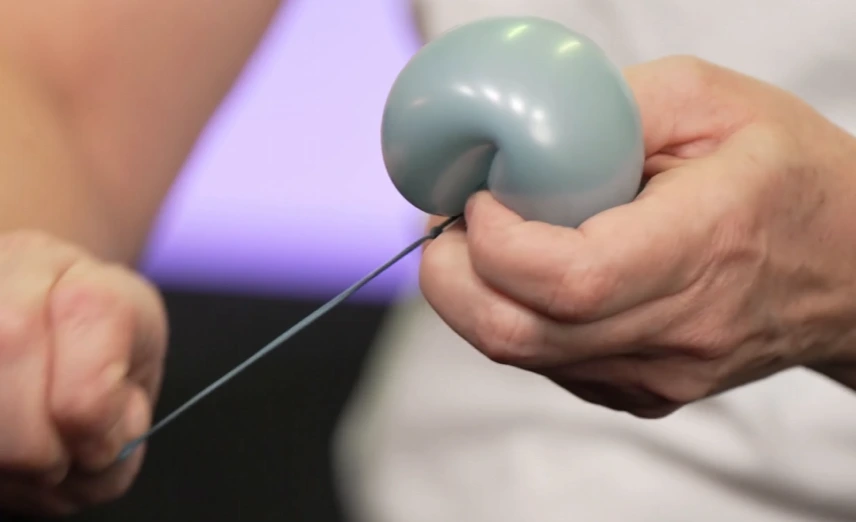
- Measure each subsequent loop against the first. The loops don't have to be perfect yet, you just want six.
- After the sixth loop, twist the entire 260 around the centre once more to lock everything in place.
- Position the petals: twist, open them, and alternate raising and lowering them until the flower looks round.
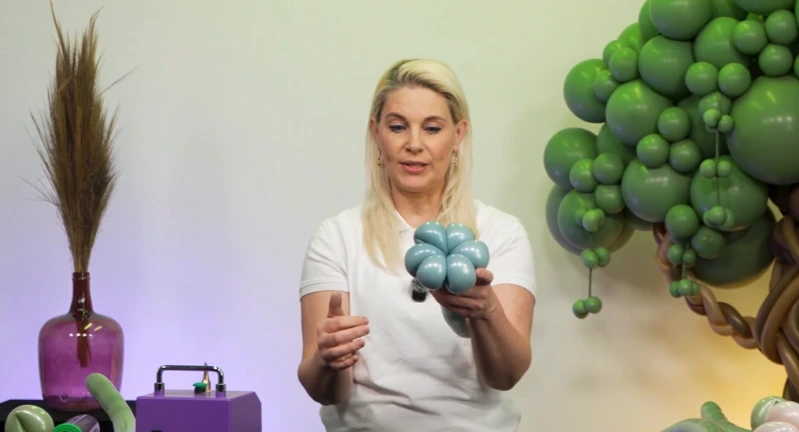
For the centre of the flower, called the heart, take a new 260 and make a small bubble. Hold it tightly, because if you let go, the air will escape. The rest of that same 260 will become the stem.
The bow and assemble the bouquet
Place the three stems together and wrap a deflated 260 around, with a very loose knot. This loose balloon is meant to keep the flowers in place. Slide the flowers up and down until you have a nice image of a real bouquet. Afterwards, you can cut the stems shorter. Never before. Those who shorten the stems and then want to move a flower end up with stems of different lengths that no longer match.
The bow is a golden 260 with a double pinch twist in the middle and two loops around it. Inflate the 260 fully and then let a little air escape. Find the middle, make a bubble there and twist it into a pinch twist, and do that again: a double pinch twist.
Make a loop on the left and right, twist it and wrap it around the pinch twist. The two ends become the ribbons: make them equal in length, twist them off and tie neatly.
Frequently asked questions
Welke ballonnen gebruik je voor ballonbloemen?
Modelleerballonnen van 260, voor alles: de bloem, de steel, het hart en de strik. Een 160 geeft fijnere bloemen, een 360 grotere, maar de 260 is de standaard om mee te leren omdat hij genoeg lengte heeft voor vijf tot zes blaadjes met een steel.
Hoeveel 260's heb je nodig voor een boeket van drie bloemen?
Ongeveer acht: één per bloem, één per steel, één voor de strik en één niet-opgeblazen 260 om de stelen te bundelen. Per extra bloem komen er twee bij, een voor de bloem en een voor de steel.
Wat is een pinch twist?
Een kleine bubbel die je van je weg trekt en twee of drie keer rond zijn eigen as draait, zodat hij omklapt en vast tegen de ballon zit. Pinch twists vormen de textuur van de lavendel, de hoek van een bloem op haar steel en het midden van een strik. Maak ze iets kleiner dan een gewone bubbel en allemaal even groot.
Waarom kom ik ruimte tekort aan het einde van mijn bloem?
Twee oorzaken: je hebt de ballon te ver opgeblazen, of je loops zijn te groot. Laat altijd een flink stuk staart vrij en hou loops op twee tot drie vingers.
Kan je ballonbloemen op een ballonboog bevestigen?
Ja. Maak op de boog een paar bevestigingspunten, pak een nek van een ballon uit de boog en knoop die aan het verbindingspunt achteraan de bloem. Verspreid de bloemen onregelmatig over de boog, dat oogt natuurlijker dan een vast patroon.
Which balloons do you use for balloon flowers?
260 modelling balloons, for everything: the flower, the stem, the centre and the bow. A 160 gives finer flowers, a 360 bigger ones, but the 260 is the standard to learn with because it has enough length for five to six petals with a stem.
How many 260s do you need for a bouquet of three flowers?
About eight: one per flower, one per stem, one for the bow and one uninflated 260 to bundle the stems. Every extra flower adds two, one for the flower and one for the stem.
What is a pinch twist?
A small bubble that you pull away from you and twist two or three times around its own axis, so it folds over and sits tight against the balloon. Pinch twists create the texture of the lavender, the angle of a flower on its stem and the centre of a bow. Make them slightly smaller than a regular bubble and all the same size.
Why do I run out of room at the end of my flower?
Two causes: you inflated the balloon too far, or your loops are too big. Always leave a generous uninflated tail and keep loops at two to three fingers.
Can you attach balloon flowers to a balloon arch?
Yes. Create a few attachment points on the arch, take a neck from a balloon in the arch and tie it to the connection point at the back of the flower. Spread the flowers irregularly across the arch, that looks more natural than a fixed pattern.
Quels ballons utiliser pour des fleurs en ballons?
Des ballons a modeler 260, pour tout: la fleur, la tige, le coeur et le noeud. Un 160 donne des fleurs plus fines, un 360 des fleurs plus grandes, mais le 260 est le standard pour apprendre, car il a assez de longueur pour cinq a six petales avec une tige.
Combien de 260 faut-il pour un bouquet de trois fleurs?
Environ huit: un par fleur, un par tige, un pour le noeud et un 260 non gonfle pour rassembler les tiges. Chaque fleur supplementaire en ajoute deux, un pour la fleur et un pour la tige.
Qu'est-ce qu'un pinch twist?
Une petite bulle que vous tirez vers l'exterieur et que vous tournez deux ou trois fois sur son axe, pour qu'elle se replie et reste bien serree contre le ballon. Les pinch twists creent la texture de la lavande, l'angle d'une fleur sur sa tige et le centre d'un noeud. Faites-les un peu plus petits qu'une bulle normale et tous de la meme taille.
Pourquoi est-ce que je manque de place a la fin de ma fleur?
Deux causes: vous avez trop gonfle le ballon, ou vos boucles sont trop grandes. Laissez toujours une bonne longueur non gonflee et gardez des boucles de deux a trois doigts.
Peut-on fixer des fleurs en ballons sur une arche de ballons?
Oui. Creez quelques points d'attache sur l'arche, prenez le col d'un ballon de l'arche et nouez-le au point de connexion a l'arriere de la fleur. Repartissez les fleurs de facon irreguliere sur l'arche, c'est plus naturel qu'un motif fixe.
Welche Ballons verwendet man fuer Ballonblumen?
Modellierballons in 260, fuer alles: die Bluete, den Stiel, die Mitte und die Schleife. Ein 160er ergibt feinere Blumen, ein 360er groessere, aber der 260er ist der Standard zum Lernen, weil er genug Laenge fuer fuenf bis sechs Blaetter mit Stiel hat.
Wie viele 260er braucht man fuer einen Strauss aus drei Blumen?
Etwa acht: einen pro Bluete, einen pro Stiel, einen fuer die Schleife und einen nicht aufgeblasenen 260er, um die Stiele zu buendeln. Jede weitere Blume braucht zwei mehr, einen fuer die Bluete und einen fuer den Stiel.
Was ist ein Pinch Twist?
Eine kleine Blase, die du von dir wegziehst und zwei- oder dreimal um die eigene Achse drehst, sodass sie umklappt und fest am Ballon anliegt. Pinch Twists bilden die Textur des Lavendels, den Winkel einer Blume auf ihrem Stiel und die Mitte einer Schleife. Mach sie etwas kleiner als eine normale Blase und alle gleich gross.
Warum fehlt mir am Ende meiner Blume der Platz?
Zwei Ursachen: du hast den Ballon zu weit aufgeblasen, oder deine Schlaufen sind zu gross. Lass immer ein grosszuegiges Stueck unaufgeblasen und halte die Schlaufen bei zwei bis drei Fingern.
Kann man Ballonblumen an einem Ballonbogen befestigen?
Ja. Schaffe ein paar Befestigungspunkte am Bogen, nimm den Hals eines Ballons aus dem Bogen und knote ihn an den Verbindungspunkt hinten an der Blume. Verteile die Blumen unregelmaessig ueber den Bogen, das wirkt natuerlicher als ein festes Muster.
Welke ballonnen gebruik je voor ballonbloemen?
Modelleerballonnen van 260, voor alles: de bloem, de steel, het hart en de strik. Een 160 geeft fijnere bloemen, een 360 grotere, maar de 260 is de standaard om mee te leren omdat hij genoeg lengte heeft voor vijf tot zes blaadjes met een steel.
Hoeveel 260's heb je nodig voor een boeket van drie bloemen?
Ongeveer acht: één per bloem, één per steel, één voor de strik en één niet-opgeblazen 260 om de stelen te bundelen. Per extra bloem komen er twee bij, een voor de bloem en een voor de steel.
Wat is een pinch twist?
Een kleine bubbel die je van je weg trekt en twee of drie keer rond zijn eigen as draait, zodat hij omklapt en vast tegen de ballon zit. Pinch twists vormen de textuur van de lavendel, de hoek van een bloem op haar steel en het midden van een strik. Maak ze iets kleiner dan een gewone bubbel en allemaal even groot.
Waarom kom ik ruimte tekort aan het einde van mijn bloem?
Twee oorzaken: je hebt de ballon te ver opgeblazen, of je loops zijn te groot. Laat altijd een flink stuk staart vrij en hou loops op twee tot drie vingers.
Kan je ballonbloemen op een ballonboog bevestigen?
Ja. Maak op de boog een paar bevestigingspunten, pak een nek van een ballon uit de boog en knoop die aan het verbindingspunt achteraan de bloem. Verspreid de bloemen onregelmatig over de boog, dat oogt natuurlijker dan een vast patroon.
Which balloons do you use for balloon flowers?
260 modelling balloons, for everything: the flower, the stem, the centre and the bow. A 160 gives finer flowers, a 360 bigger ones, but the 260 is the standard to learn with because it has enough length for five to six petals with a stem.
How many 260s do you need for a bouquet of three flowers?
About eight: one per flower, one per stem, one for the bow and one uninflated 260 to bundle the stems. Every extra flower adds two, one for the flower and one for the stem.
What is a pinch twist?
A small bubble that you pull away from you and twist two or three times around its own axis, so it folds over and sits tight against the balloon. Pinch twists create the texture of the lavender, the angle of a flower on its stem and the centre of a bow. Make them slightly smaller than a regular bubble and all the same size.
Why do I run out of room at the end of my flower?
Two causes: you inflated the balloon too far, or your loops are too big. Always leave a generous uninflated tail and keep loops at two to three fingers.
Can you attach balloon flowers to a balloon arch?
Yes. Create a few attachment points on the arch, take a neck from a balloon in the arch and tie it to the connection point at the back of the flower. Spread the flowers irregularly across the arch, that looks more natural than a fixed pattern.
Quels ballons utiliser pour des fleurs en ballons?
Des ballons a modeler 260, pour tout: la fleur, la tige, le coeur et le noeud. Un 160 donne des fleurs plus fines, un 360 des fleurs plus grandes, mais le 260 est le standard pour apprendre, car il a assez de longueur pour cinq a six petales avec une tige.
Combien de 260 faut-il pour un bouquet de trois fleurs?
Environ huit: un par fleur, un par tige, un pour le noeud et un 260 non gonfle pour rassembler les tiges. Chaque fleur supplementaire en ajoute deux, un pour la fleur et un pour la tige.
Qu'est-ce qu'un pinch twist?
Une petite bulle que vous tirez vers l'exterieur et que vous tournez deux ou trois fois sur son axe, pour qu'elle se replie et reste bien serree contre le ballon. Les pinch twists creent la texture de la lavande, l'angle d'une fleur sur sa tige et le centre d'un noeud. Faites-les un peu plus petits qu'une bulle normale et tous de la meme taille.
Pourquoi est-ce que je manque de place a la fin de ma fleur?
Deux causes: vous avez trop gonfle le ballon, ou vos boucles sont trop grandes. Laissez toujours une bonne longueur non gonflee et gardez des boucles de deux a trois doigts.
Peut-on fixer des fleurs en ballons sur une arche de ballons?
Oui. Creez quelques points d'attache sur l'arche, prenez le col d'un ballon de l'arche et nouez-le au point de connexion a l'arriere de la fleur. Repartissez les fleurs de facon irreguliere sur l'arche, c'est plus naturel qu'un motif fixe.
Welche Ballons verwendet man fuer Ballonblumen?
Modellierballons in 260, fuer alles: die Bluete, den Stiel, die Mitte und die Schleife. Ein 160er ergibt feinere Blumen, ein 360er groessere, aber der 260er ist der Standard zum Lernen, weil er genug Laenge fuer fuenf bis sechs Blaetter mit Stiel hat.
Wie viele 260er braucht man fuer einen Strauss aus drei Blumen?
Etwa acht: einen pro Bluete, einen pro Stiel, einen fuer die Schleife und einen nicht aufgeblasenen 260er, um die Stiele zu buendeln. Jede weitere Blume braucht zwei mehr, einen fuer die Bluete und einen fuer den Stiel.
Was ist ein Pinch Twist?
Eine kleine Blase, die du von dir wegziehst und zwei- oder dreimal um die eigene Achse drehst, sodass sie umklappt und fest am Ballon anliegt. Pinch Twists bilden die Textur des Lavendels, den Winkel einer Blume auf ihrem Stiel und die Mitte einer Schleife. Mach sie etwas kleiner als eine normale Blase und alle gleich gross.
Warum fehlt mir am Ende meiner Blume der Platz?
Zwei Ursachen: du hast den Ballon zu weit aufgeblasen, oder deine Schlaufen sind zu gross. Lass immer ein grosszuegiges Stueck unaufgeblasen und halte die Schlaufen bei zwei bis drei Fingern.
Kann man Ballonblumen an einem Ballonbogen befestigen?
Ja. Schaffe ein paar Befestigungspunkte am Bogen, nimm den Hals eines Ballons aus dem Bogen und knote ihn an den Verbindungspunkt hinten an der Blume. Verteile die Blumen unregelmaessig ueber den Bogen, das wirkt natuerlicher als ein festes Muster.
Liever kijken dan lezen?
Audrey maakt deze drie bloemen en de strik op ons Youtube kanaal. Bekijk de volledige tutorial en abonneer je op ons kanaal voor meer educatie.
Bekijk de volledige tutorial
Rather watch than read?
Audrey makes these three flowers and the bow on our YouTube channel. Watch the full tutorial and subscribe to our channel for more education.
Watch the full tutorial
Vous preferez regarder plutot que lire?
Audrey realise ces trois fleurs et le noeud sur notre chaine YouTube. Regardez le tutoriel complet et abonnez-vous a notre chaine pour plus de contenu educatif.
Regarder le tutoriel complet
Lieber schauen statt lesen?
Audrey macht diese drei Blumen und die Schleife auf unserem YouTube-Kanal. Schau dir das komplette Tutorial an und abonniere unseren Kanal fuer mehr Wissen.
Komplettes Tutorial ansehen
Liever kijken dan lezen?
Audrey maakt deze drie bloemen en de strik op ons Youtube kanaal. Bekijk de volledige tutorial en abonneer je op ons kanaal voor meer educatie.
Bekijk de volledige tutorial
Rather watch than read?
Audrey makes these three flowers and the bow on our YouTube channel. Watch the full tutorial and subscribe to our channel for more education.
Watch the full tutorial
Vous preferez regarder plutot que lire?
Audrey realise ces trois fleurs et le noeud sur notre chaine YouTube. Regardez le tutoriel complet et abonnez-vous a notre chaine pour plus de contenu educatif.
Regarder le tutoriel complet
Lieber schauen statt lesen?
Audrey macht diese drei Blumen und die Schleife auf unserem YouTube-Kanal. Schau dir das komplette Tutorial an und abonniere unseren Kanal fuer mehr Wissen.
Komplettes Tutorial ansehen